Pokemon Card Condition: Near Mint vs Lightly Played When Buying Raw
By Lee, founder of ChaseBoard6 min read
Published October 17, 2026. Updated October 17, 2026.
The short answer
A Near Mint (NM) card looks unplayed: a nearly unmarked surface, crisp corners and clean edges, with at most a few slight flaws such as a little edge wear or a couple of minor scratches. A Lightly Played (LP) card can have minor edge wear, scuffs or scratches that you notice, but nothing severe, no creases and nothing that weakens the card. On a raw listing, either label is the seller's opinion, so check it against the photos, and ask for more when the photos cannot settle it.
The two published scales a buyer runs into
Raw (ungraded) cards are sold on a five-step scale: Near Mint, Lightly Played, Moderately Played, Heavily Played and Damaged (see Near Mint and card condition (NM to DMG)). Two marketplaces publish their definitions, and they don't line up exactly. That matters when the same card is listed on both.
| TCGplayer | eBay, collectible card games | What changes |
|---|---|---|
| Near Mint | Near Mint or Better | eBay folds Mint into the top step. TCGplayer does not sell Mint at all |
| Lightly Played | Lightly Played (Excellent) | Minor wear on both. eBay's table allows minor creases here; on TCGplayer any crease means Moderately Played at best |
| Moderately Played | Moderately Played (Very Good) | Obvious wear; creases allowed |
| Heavily Played | Heavily Played (Poor) | Heavy wear, but the card must still hold together on TCGplayer |
| Damaged | (no separate step) | Tears, writing, structural damage |
On eBay, ungraded card condition is a field the seller picks from that list. eBay's guide describes each step by corners, edges, discoloration, indentations, creases, scratches and staining. For Lightly Played it allows moderate chipping, indentation or scratches, as long as the card does not look heavily handled. Its sports and non-sports card scale uses the second names only (Excellent, Very Good, Poor), so you may see those words on Pokemon listings too.
TCGplayer goes further and measures each flaw. Its standards cover cards sold through its marketplace, and they're the most detailed public definition of NM and LP this guide could find, so they're the ruler it uses.
Where the line between NM and LP falls
From TCGplayer's comprehensive conditioning guide:
Edge wear. A stretch of edge wear up to 20 mm long is allowed at Near Mint. From 20 mm to 80 mm, the card is Lightly Played at best.
Whitening that exposes the card stock. TCGplayer calls this surface wear once it reaches more than half a millimetre in from the edge. Even a slight patch rules out Near Mint.
Scuffing. A small scuffed area is allowed at Near Mint. A larger patch, up to half of one side, caps the card at Lightly Played.
Scratches. Hairline scratches up to 40 mm are allowed at any condition, so a scratch alone rarely decides NM versus LP.
Bends and creases. A small bend of 10 mm or less with no crease caps the card at Lightly Played. Any crease drops it to Moderately Played at best.
Dirt and smudges. Even a slight patch of grime rules out Near Mint.
Centering. Up to 70/30 does not affect condition at all. Worse than 70/30 makes the card Damaged on TCGplayer.
Foil cards follow the same rules, though TCGplayer notes that flaws show more on foil. So on a holo, use the same rules and look harder.
What listing photos can and cannot show
| Flaw | In a clear photo | What to ask for |
|---|---|---|
| Centering | Yes: compare the border widths, left to right and top to bottom | Nothing, if the photo is straight on |
| Edge whitening | Often, especially on the blue back | A sharp photo of the back |
| Corner wear | Sometimes, if the photo is close | Close-ups of all four corners |
| Scratches and holo wear | Rarely in a flat scan; they show only when light hits the foil | A short video tilting the card under a light |
| Small bends and dents | Almost never | A photo or video at a low angle to a light |
| Grime | Sometimes | A clear photo of the surface |
Condition can be hard to judge from photos. Sometimes I cannot tell from the listing, so I ask the seller for a video or a good photo. A seller's Near Mint has not turned out worse for me, because I check it well before I buy. When the price is exceptionally low or the card is ungraded, I ask for more photos or a video, especially when I am buying Near Mint.
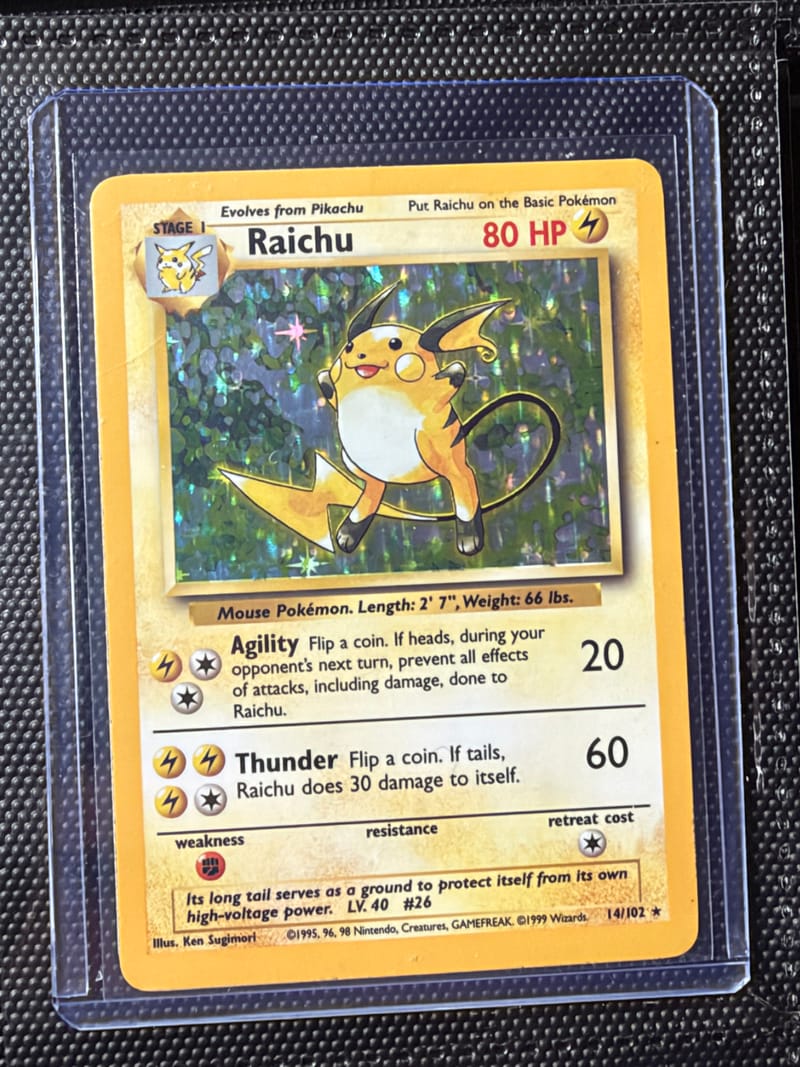
What to ask a seller
Message the seller before you buy. These five requests settle most NM versus LP questions:
A photo of the back, in full. Edge wear and whitening are often easiest to spot there.
Close-ups of the four corners, front and back.
A short video tilting the card under a light. This is the only way to see scratches and holo wear on a raw listing.
Whether the card has been played or stored out of a sleeve.
Whether the photos are of this exact card, not a stock image or another copy.
A seller who won't send these is telling you something. If the price is low and the answers are vague, treat the card as Lightly Played or worse, and decide on that basis.
Centering is not condition, until you grade
Raw condition scales barely care about centering: TCGplayer ignores it up to 70/30. Graders care a lot. PSA's standard for a Gem Mint 10 asks for centering of about 55/45 or better on the front. So a Near Mint raw card can be a poor candidate for a high grade purely because it is off center, even with perfect corners. If you're buying raw to grade, check the centering in the photo yourself. It's the one thing a straight-on photo shows well. What each grader's top grade means is in PSA vs CGC vs BGS vs TAG for Pokemon Cards, and the trade-off between the two kinds of card is in Graded vs raw cards.
Filtering by condition on ChaseBoard
A raw ChaseBoard watch can accept one condition or several, from Near Mint, Lightly Played, Moderately Played, Heavily Played and Damaged. It matches either the short code or the full name in the listing title, such as "LP" or "Lightly Played", and a Near Mint watch also takes "Mint" and "pack fresh", but not "Gem Mint", which is slab wording. With a condition set, it skips graded slabs. Leave the conditions empty to accept any condition, slabs included. Either way, check the photos yourself before you buy.
A checklist before you buy raw
Real photos of the front and back, not stock images
Back edges checked for whitening
All four corners visible and sharp
For a holo: a tilt video, or a photo with light on the foil
No crease or bend visible at an angle
Centering checked, if you might grade it
The seller's condition label matches what you see
Price makes sense for the condition you actually see, not the one in the title
FAQ
Near Mint looks unplayed, with at most a few slight flaws. Lightly Played shows minor but noticeable wear, such as edge whitening, scuffs or light scratches, with no creases or structural damage. On TCGplayer, any whitening that exposes the card stock, or any visible dirt, rules out Near Mint.
It means visible but minor wear and no creases. Whether that is good enough depends on what you want the card for: fine for a binder if light wear does not bother you, but not a candidate for a top grade.
Look at a straight-on photo and compare the border width on the left with the right, then the top with the bottom. Equal borders are 50/50. If one border is much thinner than its opposite, the card is off center.
On TCGplayer, not up to 70/30. Beyond that, the card counts as Damaged. Centering matters much more for grading.
It is the seller's opinion, chosen from eBay's condition list. Check it against the photos, and ask for close-ups or a video when you cannot tell.
Sellers use it for "Near Mint to Mint". eBay's own top step is "Near Mint or Better". It is still a claim, not a grade.
Related
Sources
- TCGplayer Help Center, "Card Conditioning Overview" (updated 2026-10-08), read October 9, 2026
- TCGplayer Help Center, "Understanding Card Condition Imperfections: A Comprehensive Guide" (updated 2026-09-27), read October 9, 2026
- eBay, card condition guidelines, read October 9, 2026
- eBay Developers, condition descriptor IDs for trading cards (ungraded condition values), read October 9, 2026
- PSA, Grading Standards, read October 9, 2026
Last reviewed October 9, 2026.
How this page was written: drafted with AI assistance from Lee's own answers, then checked claim by claim against the sources above.
About the author
Lee, founder of ChaseBoard
Lee buys Pokemon cards on eBay and builds ChaseBoard.