How to Complete a Pokemon Master Set
By Lee, founder of ChaseBoard6 min read
Published October 17, 2026. Updated October 17, 2026.
The short answer
To complete a Pokemon master set, decide your rules first, build a checklist by card number and version, open packs or buy singles to cover the common cards, then hunt the last few singles one by one. A master set is every card in a set in every version it was printed in: each card number, including the secret rares numbered above the set total, plus every reverse holo, and for Wizards of the Coast sets the 1st Edition and Unlimited prints (and Shadowless for Base Set).
What counts in a master set
There is no official definition, so collectors draw the edges differently (see Master set). The core is the same everywhere: one of every card, in every version printed in the set's packs. The arguments are about the extras.
| Modern sets (Scarlet & Violet, Mega Evolution) | Wizards of the Coast sets (1999-2003) | |
|---|---|---|
| Always in | Every card number up to the set total, every secret rare above it, every reverse holo | Every card number, in each print the set had |
| Prints to collect | Regular print and reverse holo of each common, uncommon and rare | 1st Edition and Unlimited; Base Set also has Shadowless |
| Often argued about | Set-specific promos, stamped versions, extra reverse holo patterns | Print variations a grader lists separately, such as copyright-year or error versions |
| Usually left out | Cards from other sets in the same product, oversize cards | Box toppers and jumbo cards |
Two worked examples.
Phantasmal Flames has 94 cards in its numbered set and 36 more numbered above it, 130 in all. TCGdex lists a reverse holo for 84 of them: every common, uncommon and rare. That makes at least 214 cards before any promos.
Base Set has 102 cards, and TCGdex flags all 102 with a 1st Edition print. With the three prints (1st Edition, Shadowless, Unlimited), that is 306 cards. CGC's census also lists the three prints as separate sets. Telling them apart from a photo is covered in 1st Edition vs Shadowless Pokemon Cards.
Write your rules down before you buy anything. A master set that quietly grows to take in every promo and stamp is the one you never finish.
Build your checklist
Start from a full card list that shows variants, not just names. TCGdex, a free card database, lists every card in a set with flags for which versions exist (normal, holo, reverse holo, 1st Edition).
Give every card one row per version. It looks like overkill until the first reverse holo goes missing:
| Number | Card | Version | Have | Condition | Where from |
|---|---|---|---|---|---|
| 001/094 | (card name) | Regular | |||
| 001/094 | (card name) | Reverse holo |
Three habits keep the list honest:
Track by number and version, not by name. Several cards can share a name, and a reverse holo shares its number with the regular print (see Reverse holo and Card number (set number)).
Decide a condition floor. If you want the binder to look even, write the lowest condition you accept next to each row. Pokemon Card Condition: Near Mint vs LP covers judging raw condition from photos.
Mark what you bought where. When a card arrives as the wrong version, you'll want to know which listing it came from, so note it the day you buy.
Packs or singles
Both work. Most people mix them.
Packs fill the commons, uncommons and their reverse holos quickly, and opening is the fun part. The catch is duplicates. The cards you already have keep coming, and the top rarity tiers are the hardest to pull. Pokemon does not publish pull rates, so there's no way to plan how many packs it takes.
Singles let you buy exactly the card and version you're missing. They're the practical way to the last few cards. For Wizards-era sets, where you're unlikely to open packs at all, singles are most of the work.
A simple plan: open some product early, then switch to singles once most of your pulls are duplicates. Buying cheap commons in larger orders from one seller saves on shipping. Read what a "set" or "lot" listing actually contains before you buy it.
The hard cards
Every master set ends with the same few problems.
The top rarity tiers. In modern sets these are the cards numbered above the set total, such as Special Illustration Rares and Mega Hyper Rares (see Special Illustration Rare (SIR) and alt art). Phantasmal Flames has 36 cards above its set total, and the scarcest tiers among them are its chase cards.
Reverse holos of commons. Cheap, but often badly titled: no number, or "holo" without "reverse". They cost time, not money, so search for them by number.
The scarcer prints of old sets. For Base Set, CGC's census shows the three prints are far from even; Base Set Charizard's counts by print are in The Rarest Charizard Cards, Set by Set. Look up the other holos the same way before you plan a Base Set master set.
Condition. Finding a card is one problem. Finding it in the same condition as the rest of your binder is another, especially for vintage holos. Hold out for the copy that matches.
My Base Set
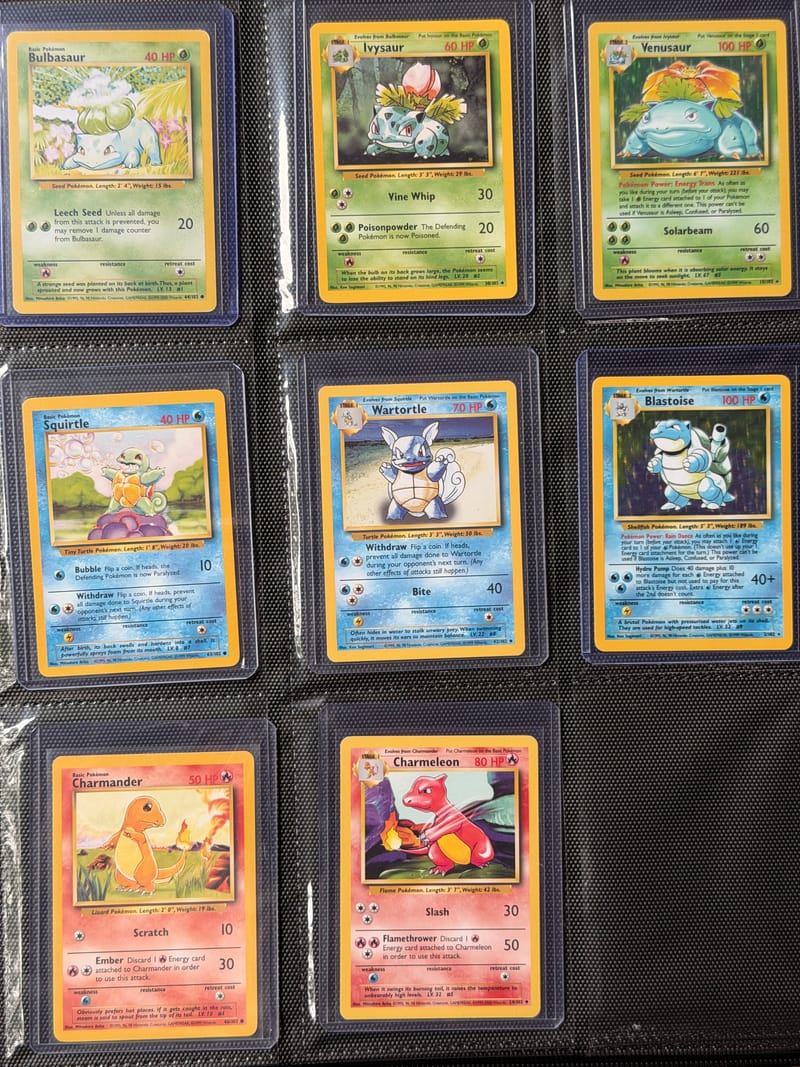
My rule for Base Set is Unlimited only, so mine is a complete set of 102 cards rather than a 306-card master set. That's what deciding your rules first looks like. I have almost completed it. I am missing about two common Trainer cards, and they are still the last gaps.
That's the lesson: the commonest cards can be the last gap. When one is all you're missing, search for its number and print, not its name.
Finding the last cards on eBay
Search by card number plus version, such as "4/102 unlimited", or a number plus "reverse holo", rather than the Pokemon's name alone.
Check the photo for the version. The 1st Edition stamp, the shadow on a Base Set art box, the reverse holo foil around the art. Titles get these wrong.
Skip lots for the last cards. A lot fills many rows at once, but rarely the ones you need.
Check the back and corners before you pay. One card in the wrong condition stands out in a finished binder.
You don't have to run those searches by hand every day. On ChaseBoard, every missing card can be its own watch: add it from the catalog, pick the Reverse Holo, Holo or 1st Edition chip where the catalog lists that print, set your target price, and you get an alert when a matching listing appears. For an Unlimited Base Set card, add "1st edition" and "shadowless" as exclude words so the other prints do not alert you. ChaseBoard skips listings titled as lots, so it suits the last singles more than bulk buying.
Master set checklist
Rules written down: which promos, stamps and variations count
Full list by number and version, secret rares included
Reverse holos listed as their own rows
Wizards-era sets: 1st Edition, Unlimited (and Shadowless for Base Set) as separate rows
A condition floor for each row
Packs for the commons, singles for the rest
Each missing card searched by number plus version
Photos checked for stamp, shadow and foil before paying
FAQ
It depends on the set and your rules. Phantasmal Flames has 130 card numbers plus 84 reverse holos, at least 214 cards. Base Set's three prints of 102 cards make 306.
A complete set is usually one copy of each card number. A master set adds every version of each card, such as reverse holos or 1st Edition prints.
Collectors disagree. Some include promos made for the set, such as cards from that set's boxes and collections. Decide before you start and write it in your checklist.
You can do both: packs for the commons, uncommons and reverse holos, singles for the high rarities and the last missing cards. Pokemon does not publish pull rates, so packs cannot be planned precisely.
A term some collectors use for a master set plus every extra they can find, such as promos, stamps and print variations.
Related
Sources
- TCGdex, Phantasmal Flames set and card data (variants, rarities), read October 9, 2026
- TCGdex, Base Set set and card data, read October 9, 2026
- CGC Cards, Population Report, Original Series (English Base Set groups; report updated 2026-10-08), read October 9, 2026
Last reviewed October 9, 2026.
How this page was written: drafted with AI assistance from Lee's own answers, then checked claim by claim against the sources above.
About the author
Lee, founder of ChaseBoard
Lee buys Pokemon cards on eBay and builds ChaseBoard.