1st Edition, Shadowless or Unlimited Pokemon Card? How to Tell
By Lee, founder of ChaseBoard7 min read
Published October 17, 2026. Updated October 17, 2026.
The short answer
A 1st Edition card has a small black "Edition 1" stamp at the lower left of its artwork. On English Base Set only, a Shadowless card has no stamp and no drop shadow around the art box, and an Unlimited card has the shadow and bolder HP and attack text. Every other set is simpler: if the stamp is there it is 1st Edition, and if it is not, it is Unlimited.
The three Base Set prints at a glance
English Base Set (1999) was printed in four runs, according to Bulbapedia's set history. Collectors usually talk about three, because the fourth is an Unlimited card with a newer date.
| 1st Edition stamp | Drop shadow around the art | HP and attack text | Copyright line | |
|---|---|---|---|---|
| 1st Edition (first run) | Yes | No | Thinner | Same as Shadowless |
| Shadowless (second run) | No | No | Thinner | Trainer and Energy cards read "1995, 96, 98, 99 Nintendo" |
| Unlimited (third run) | No | Yes | Bolder | Trainer and Energy cards read "1995, 96, 98 Nintendo" |
| Unlimited, later run | No | Yes | Bolder | Wizards date reads 1999-2000 instead of 1999 |
So the 1st Edition and Shadowless prints are the same card apart from the stamp, and Shadowless and Unlimited differ in the shadow and the text weight. A 1st Edition Base Set card is always shadowless (see Shadowless).
Step 1: find the stamp
The stamp is the whole story outside Base Set. It is a small black circle with "Edition" and a large "1", printed at the lower left of the art box. On sets that have a set symbol, it sits opposite that symbol. Base Set has no set symbol, so on a Base Set card the stamp is the only mark in that spot.
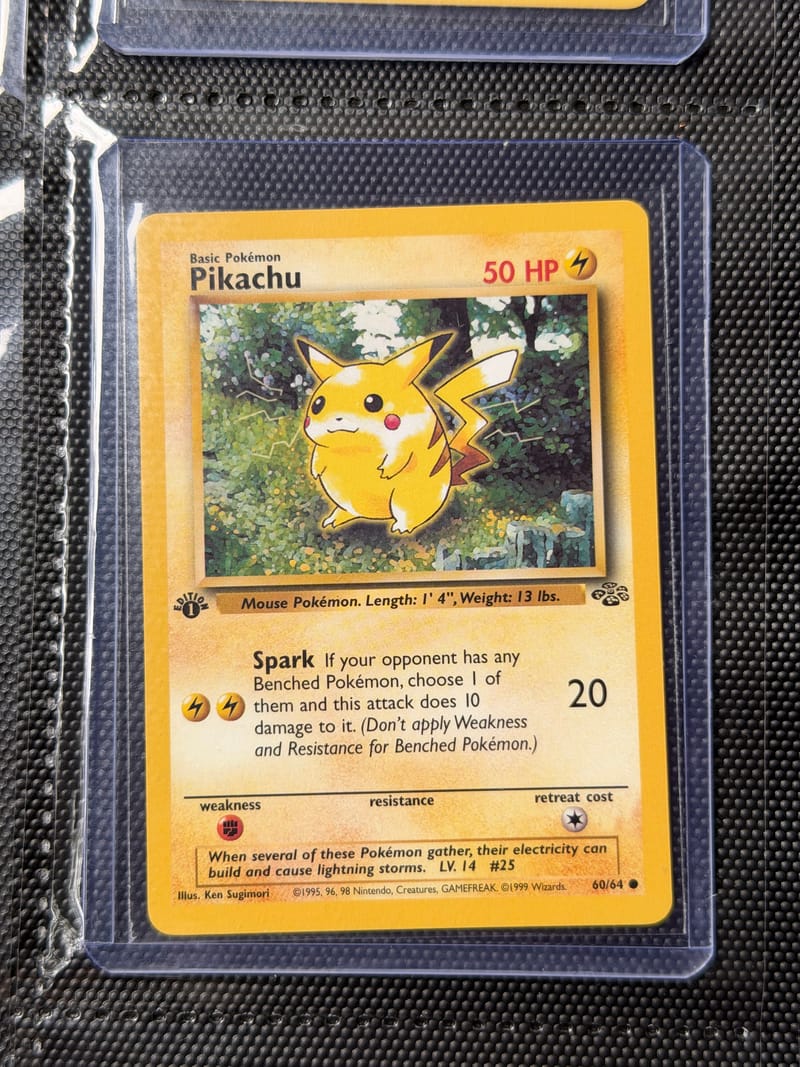
On a listing, that means the photo has to show the lower left corner of the art clearly. If it is cropped, blurred or covered by glare, ask the seller for a closer shot before you pay. A title that says "1st Edition" proves nothing on its own.
The stamp also appeared on 1st Edition booster packs and boxes, which helps when you are looking at sealed product. More on the term itself is in First edition (1st Edition).
Step 2, Base Set only: the shadow and the text
If a Base Set card has no stamp, it is either Shadowless or Unlimited. Look at the frame around the artwork. On an Unlimited card a dark drop shadow runs along it, so the art looks slightly raised. On a Shadowless card the frame is flat, with no shadow.
The text is the second check. Shadowless cards (like 1st Edition ones) print the HP and attack text thinner. Unlimited cards print it bolder. Side by side with an official scan, the difference is easy to see. In a single small photo it is not, so compare against a known example.
Trainer and Energy cards have no art window, so there is no shadow to check. Bulbapedia's guide says the copyright line tells them apart: Shadowless cards include "99" after "1995, 96, 98", and Unlimited cards leave it out. That line is tiny, so ask for a sharp photo of the bottom of the card if the listing doesn't have one.
Two things trip people up here:
Shadowless is an English Base Set thing. In other languages, Base Set 1st Edition cards were printed with the shadow and the bolder text. A German or French 1st Edition card with a shadow is normal, not a fake.
"Shadowless" on a Jungle or Fossil card is a mistake. Those sets were printed with the shadow from the start. Only the stamp separates 1st Edition from Unlimited there.
Which sets had a 1st Edition run
Wizards of the Coast printed a 1st Edition run for its early English sets up to Neo Destiny, with one exception in the middle: Base Set 2. After Neo Destiny, the English game never used the stamp again.
| Set | Released | 1st Edition run | Shadowless print |
|---|---|---|---|
| Base Set | January 1999 | Yes | Yes |
| Jungle | June 1999 | Yes | No |
| Fossil | October 1999 | Yes | No |
| Base Set 2 | February 2000 | No | No |
| Team Rocket | April 2000 | Yes | No |
| Gym Heroes, Gym Challenge | August, October 2000 | Yes | No |
| Neo Genesis | December 2000 | Yes | No |
| Neo Discovery, Neo Revelation | June, September 2001 | Yes | No |
| Southern Islands | July 2001 | No | No |
| Neo Destiny | February 2002 | Yes (the last one) | No |
| Legendary Collection | May 2002 | No | No |
| Expedition, Aquapolis, Skyridge | 2002-2003 | No | No |
| Every set since | 2003 onward | No | No |
Release dates are from TCGdex. As for why the run ended, Bulbapedia's account is that by the later Neo sets, 1st Edition prints were reaching stores at the same time as the Unlimited ones, or after them, so the stamp stopped meaning "first". Legendary Collection introduced reverse holos instead (see Holo vs Reverse Holo Pokemon Cards).
Where listings get it wrong
Most mislabels come from four patterns. Check every vintage title against them:
"1st Edition" on Base Set 2, Legendary Collection or a modern card. None of those had a 1st Edition run, so the title is wrong whatever the photo shows.
"1999" read as "1st Edition". Every Base Set print carries a 1999 date, Unlimited included. The date tells you the set, not the print.
"Shadowless" on any set other than Base Set, as above.
"1st Edition holo" for a non-holo card. In Jungle and Fossil the same Pokemon was printed as a holo and as a non-holo rare, and both came in 1st Edition. The stamp tells you the print run, not the foil. The card number does: Jungle Vaporeon 12/64 is the holo and 28/64 the non-holo.
I learned that last one the hard way, with a Jungle Vaporeon (the full story).
ChaseBoard handles the set rules for you where it can. When you add a card that was printed in 1st Edition, a 1st Edition chip appears, and selecting it means only titles that say 1st Edition (or First Edition) match. A Base Set watch skips listings titled "Base Set 2", and a Base Set 2 watch does not treat "1st Edition" as a sign that a listing belongs to that set, because Base Set 2 never had one. The photo is still your check.
Graded copies: read the label
Graders treat the prints as different cards. CGC's population report, for example, lists Base Set 1st Edition, Base Set Shadowless and Base Set Unlimited as three separate sets. So on a slab, the label should name the print you are paying for.
Read the label in the photo, then look the cert number up on the grader's site and check it shows the same print (see Cert number (certification number) and Verify a Graded Pokemon Card Before You Buy). If a title says Shadowless and the label doesn't, believe the label.
Buying vintage from a photo
Most of my collection is vintage: Base Set, Jungle, Neo Genesis and Neo Revelation, along with movie promos and Black Star promos. When I buy one, the first thing I check is the print: 1st Edition, Shadowless or Unlimited. Then the copyright line and the year, because a card can look almost the same and turn out to be a much newer reprint. Evolutions, released in November 2016, brought back the Base Set designs, Mitsuhiro Arita's Charizard included, so read the date before you trust the art. After that it's the same three checks as any card: the condition, the seller's feedback, and whether it's authentic.
For cards like these, a title is a claim, not proof. The photo has to show the lower left of the art box for the stamp, and on Base Set, the frame around the art for the shadow. If it doesn't show both, ask for a photo that does.
A checklist before you buy
The set had a 1st Edition run (table above)
The stamp is visible in the photo, lower left of the art
Base Set without a stamp: shadow or no shadow around the art box, thin or bold HP text
Base Set Trainer or Energy: the copyright line is readable
"Shadowless" appears only on an English Base Set card
The card number matches the version you want (holo or non-holo)
For a slab: the label names the same print, and the cert lookup agrees
FAQ
Look for the black "Edition 1" stamp at the lower left of the artwork. If it is there and the set had a 1st Edition run (Base Set to Neo Destiny, except Base Set 2), the card is 1st Edition. No stamp means it is not.
No. Base Set, Jungle and Fossil all came out in 1999 and each had both 1st Edition and Unlimited prints. The 1999 date is on Unlimited cards too. Only the stamp marks a 1st Edition card.
Yes. That is the Shadowless print: English Base Set's second run, with no stamp but the same thin text and missing shadow as the 1st Edition run.
Neither Wizards of the Coast nor Pokemon has published a print-run figure for any Base Set print, as far as the sources checked for this page show. Grading companies publish how many copies they have graded of each print, which counts graded copies only (see Pop report (population report)). For Base Set Charizard, the counts by print are in The Rarest Charizard Cards, Set by Set.
Yes, in English the stamp is what marks a 1st Edition card. Japanese sets started their own 1st Edition runs in 2001 with a different mark, so the English rules above don't apply to them.
A holo 1st Edition Machamp came in the early Base Set starter decks, not only in booster packs, so far more copies reached collectors. CGC's graded counts show it; the numbers are in The Rarest Pokemon Cards, and How We Know.
Related
Sources
- Bulbapedia, Base Set (TCG), section on English print runs, read October 9, 2026
- Bulbapedia, 1st Edition (TCG), including the Shadowless section, read October 9, 2026
- TCGdex, set data for Base Set to Expedition (release dates, 1st Edition variants), read October 9, 2026
- TCGdex, Evolutions (release date) and its Charizard 11/108 (illustrator), read October 10, 2026
- TCGdex, Jungle Vaporeon 12/64 (holo), read October 9, 2026
- TCGdex, Jungle Vaporeon 28/64 (non-holo), read October 9, 2026
- CGC Cards Population Report, Base Set 1st Edition (English), read October 9, 2026
Last reviewed October 10, 2026.
How this page was written: drafted with AI assistance from Lee's own answers, then checked claim by claim against the sources above.
About the author
Lee, founder of ChaseBoard
Lee buys Pokemon cards on eBay and builds ChaseBoard.