The Rarest Pokemon Cards, and How We Know
By Lee, founder of ChaseBoard8 min read
Published October 17, 2026. Updated October 17, 2026.
The short answer
The rarest Pokemon cards were never sold in packs. They are contest prizes, tournament trophies and test prints that exist in the dozens or fewer, and the best documented is the Pokemon Illustrator, often called Pikachu Illustrator: 39 copies were awarded through art contests in 1997 and 1998, and 41 are known today. For cards that came from packs, no print runs are published. The best evidence you can measure is a grading company's population report, and that counts graded copies, not every copy.
Why this page has no prices
Most "rarest card" lists are really price lists. A sale price tells you what one buyer paid on one day, not how many copies exist, and it changes. So this page ranks nothing by value. Every count below says where it came from, and anything without a strong source is marked as unproven.
How strong is the evidence?
Rarity claims are not equal, and the first question to ask about any of them is what kind of evidence sits behind it. From strongest to weakest:
| Kind of evidence | What it tells you | Example |
|---|---|---|
| A record from whoever handed the cards out | How many were awarded or distributed | Pokemon Illustrator: winners announced in CoroCoro Comic |
| An estimate from the event structure | Roughly how many, worked out from how many events and divisions there were | The early Japanese No.1 Trainer trophy cards |
| A grading company's research | How many examples one grader has examined and documented | CGC's study of the test print Blastoise cards |
| A population report | How many copies one grader has graded, at each grade, on the date you read it | CGC's report for 1st Edition Base Set |
| Staff accounts and hobby lore | A story, sometimes with a number attached, but no document | Prerelease Raichu |
Only the first kind is close to a true count. The rest are lower limits, estimates or stories. So when a listing or a list says "only 10 exist", ask which row of this table the number comes from.
The best-documented rare cards
These are the cards where you can trace how they were handed out. Each count is as published by the source named. None of them is an official figure from The Pokemon Company.
| Card | What it was | How many | Source |
|---|---|---|---|
| Pokemon Illustrator (Japan, 1997-98) | Prize for winners of three art contests run in CoroCoro Comic | 39 awarded, 41 known | Bulbapedia, from the magazine's award announcements; CGC (April 2025) |
| No.1 Trainer, 1997 Official Tournament (Japan) | Prize for qualifying-round champions | At least 2, estimated | Bulbapedia, worked out from the event schedule |
| No.1 Trainer, Lizardon and Kamex Mega Battle (Japan, 1997-98) | Prize for regional champions | About 14 of each print, estimated | Bulbapedia, same method |
| No.1 Trainer, Challenge Road '99 (Japan) | Prize for regional champions, two tournaments | About 9 of each print, estimated | Bulbapedia, same method |
| No.1 Trainer, World Championships (2004 on) | Prize for the winner of each age division | One per division each year | Bulbapedia |
| Test print Blastoise (Wizards of the Coast, 1998) | Early test prints of the first English card design | 5 examples documented | CGC's research article (December 2020) |
The Pokemon Illustrator count, step by step
The Illustrator count holds up because it can be rebuilt from the contest results. Bulbapedia's account, based on the CoroCoro Comic issues, gives three contests:
The first contest (winners announced in the January 1998 issue): 3 Best Award winners and 20 Excellence Award winners, each given one Illustrator card. That is 23.
The Mewtwo's Counterattack contest (July 1998 issue): 1 Best Award and 7 Excellence Awards. That is 8.
The Pikachu's Summer Vacation contest (August 1998 issue): 8 Excellence Awards, and no Best Award because that winner could not be contacted. That is 8.
23 plus 8 plus 8 is 39. CGC's own article says the same: 39 given out to contest winners, then two more released into circulation, for 41 known copies. Bulbapedia says those two surfaced around 2019-2020, after extra copies of early trophy cards began appearing at Japanese auctions.
The No.1 Trainer counts are estimates
The early Japanese No.1 Trainer cards, popularly called the Trophy Pikachu cards, are often said to exist in tiny numbers. Bulbapedia is careful here: its figures are estimates based on the dates and age divisions of each event, not a published award list.
It also corrects two common mistakes. The cards were given to the winners of regional qualifying events, not only to the overall champions of the finals, and two of the prints people date to 1998 and 1999 were in fact both awarded across late 1997 and 1998. If a famous card's basic history gets repeated wrongly, its "only X exist" figure deserves the same caution.
Modern World Championships winners also receive a No.1 Trainer card. With one winner per age division each year, that makes those cards scarce by design, and their count is one of the few you can reason out from public results.
What a pop report can and cannot tell you
A population report is a grader's count of the copies it has graded of each card, at each grade (see Pop report (population report)). It is real, published data, which makes it the most useful evidence for cards that came from packs. But it measures one thing only, and it is easy to read too much into it.
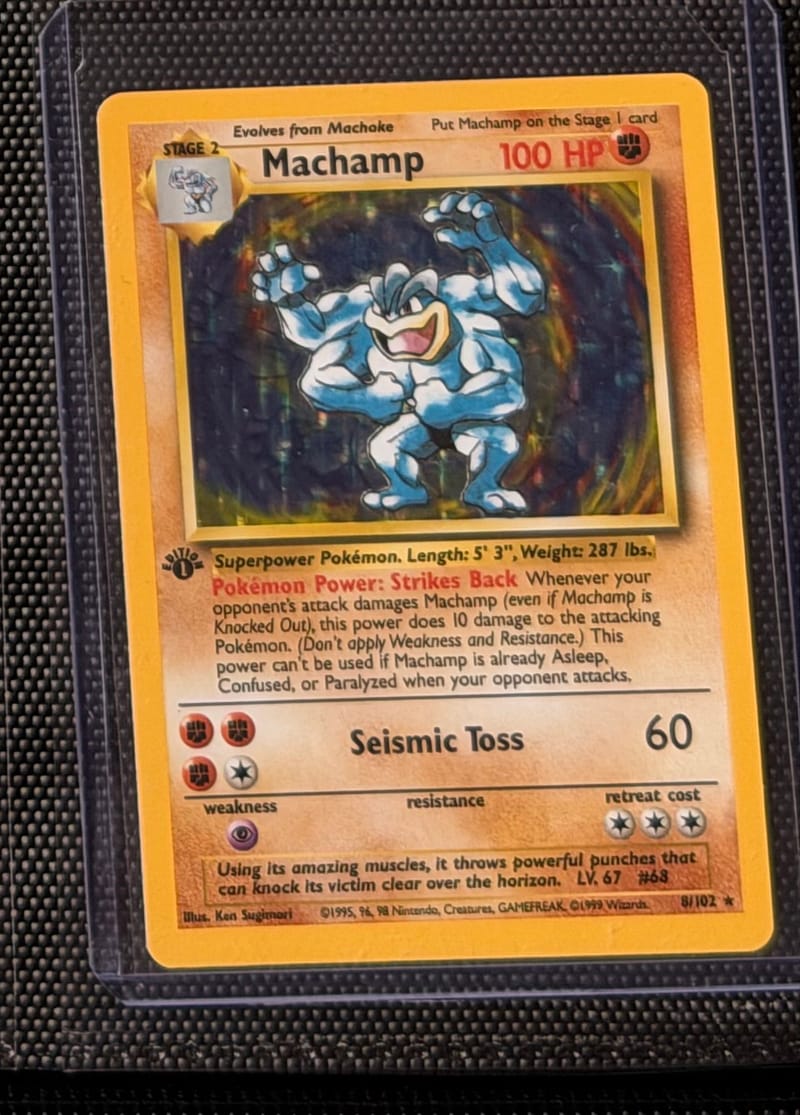
What it can show. CGC's report for English 1st Edition Base Set, last updated October 8, 2026, lists 651 graded Charizards in its main holo row and 6,961 Machamps. Machamp came with the 1st Edition stamp in the early starter decks (Bulbapedia), so far more copies reached collectors. A 1st Edition stamp alone does not make a card rare (more in 1st Edition vs Shadowless Pokemon Cards). And Charizard's 651 is higher than every other 1st Edition holo on the page except Machamp's, even though they came from the same packs. A pop report also reflects which cards people choose to grade.
What it cannot show:
Raw copies. Every ungraded card is invisible to it.
Other graders. CGC's count says nothing about PSA's, and you can't add the two together. A card can be cracked out of one slab and graded again, by the same grader or another, and the old record is not always removed.
A fixed number. Counts only grow as more cards are graded. CGC said it had certified 18 Pokemon Illustrators in April 2025, out of 41 known. That figure was true on its date, not forever.
CGC's population report is public. PSA's asks for a sign-in. Whenever you rely on a pop number, write the date next to it, and look it up yourself rather than trusting the number in a listing.
Claims to treat carefully
Prerelease Raichu. A Base Set Raichu with a "Prerelease" stamp was hobby folklore for years. Hobby news now reports graded copies, but no published record says how many were made. The numbers that circulate come from accounts attributed to former Wizards of the Coast staff, so treat any count as unproven.
"Only X exist" in a listing title. Ask the seller where the number comes from. Usually it is a pop report figure, which counts graded copies at one grader.
"Pop 1". It means one grader has graded one copy at that grade. Other copies can sit raw, at other grades, or at other graders, so don't read it as "one exists".
Modern rarity symbols. A rarity symbol tells you how a card ranks within its set, not how many copies were printed. Pokemon's support page lists what a booster pack contains, not the odds of any one card, and print runs are not published. See Pokemon Card Rarity Symbols Explained and Special Illustration Rare (SIR) and alt art.
Rarest is not the same as most wanted
My grails are personal, not famous: a Neo Genesis 1st Edition Lugia, which I'm still hunting, and a Base Set Unlimited Charizard, which I finally got. A grail is the card you want most, not the card with the smallest count (see Grail card).
If your grail is a card that does turn up for sale, you can add it to a ChaseBoard board with the grade and price range you want, and get an alert when a matching listing appears.
A checklist for any rarity claim
Which kind of evidence is it: an award record, an estimate, a grader's research, a pop report, or a story?
Who published it, and is the source linked?
If it is a pop count: which grader, and on what date?
Does it count every copy, or only graded ones?
Have you checked the grader's report yourself today?
For a slab: does the cert lookup match the card in the photo? (see Verify a Graded Pokemon Card Before You Buy)
If you can't answer the first two, treat the number as a story until you can.
FAQ
There is no official ranking. The best-documented very rare card is the Pokemon Illustrator, with 39 awarded and 41 known. Some early Japanese trophy cards are estimated at fewer copies, but those figures are estimates worked out from event schedules, not award records.
No list of five can be proven, because exact counts exist for very few cards. The ones with the strongest evidence are the Pokemon Illustrator, the early Japanese No.1 Trainer trophy cards, World Championships No.1 Trainer cards and the test print Blastoise cards documented by CGC.
39 were awarded to contest winners in 1997 and 1998, and two more appeared later, for 41 known copies, according to Bulbapedia and CGC.
It is personal. A grail is the card one collector wants most. Many name the Pokemon Illustrator because so few exist, but plenty of collectors chase a card from their childhood instead.
No. It shows how many copies one grader has graded, at each grade, on the date you read it. Raw copies and other graders' copies are not in it, and the number grows over time.
No official print run exists, so a pop report is the evidence there is, and it shows how often collectors send a card in as much as how many exist. The counts for every Charizard print, dated, are in The Rarest Charizard Cards, Set by Set.
Related
Sources
- Bulbapedia, Pokemon Illustrator (CoroCoro promo), read October 9, 2026
- Bulbapedia, No.1 Trainer (Pokemon Card Game Official Tournament promo), read October 9, 2026
- Bulbapedia, 1st Edition (TCG), read October 9, 2026
- CGC Cards, "A Powerful Duo! Two CGC-certified Pokemon Illustrators..." (April 2, 2025), read October 9, 2026
- CGC Cards, "Pokemon Test Print Blastoise" (December 7, 2020), read October 9, 2026
- CGC Cards Population Report, Base Set 1st Edition (English), read October 9, 2026
- PSA Population Report, read October 9, 2026
- Pokemon Support, "What can I expect in a Pokemon Trading Card Game booster pack?", read October 9, 2026
Last reviewed October 9, 2026.
How this page was written: drafted with AI assistance from Lee's own answers, then checked claim by claim against the sources above.
About the author
Lee, founder of ChaseBoard
Lee buys Pokemon cards on eBay and builds ChaseBoard.